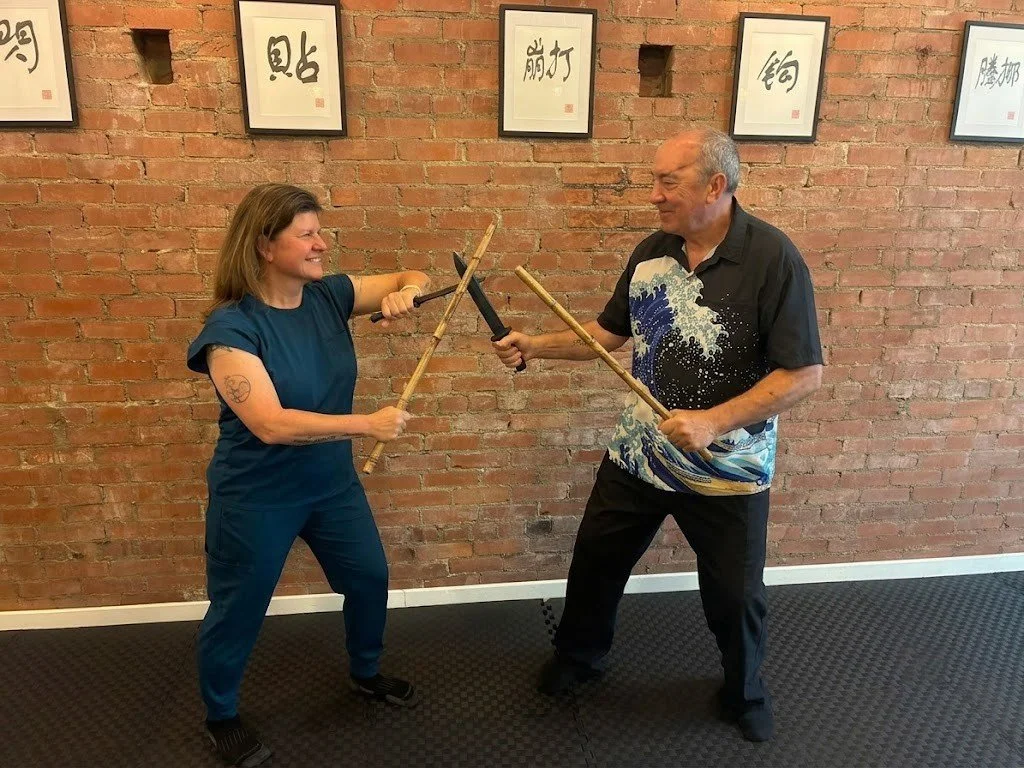
Where Filipino Kali Converges with Traditional Kung Fu Weaponry
In our academy, we don't treat weapons training as an isolated novelty or performance art. We recognize that the geometry of edged and impact combat follows universal mechanics of angles, timing, and structural intent. We teach an uncompromising integration of Filipino Kali and Traditional Kung Fu Weaponry—two battle-tested traditions that build complete mastery across every range of armed conflict.
It is a common misconception in modern martial arts that weapons training is either theatrical choreography or sport tag with foam sticks. This perspective ignores the lethal, street combat reality of both lineages. In our academy, we strip away performance flourishes and tournament restrictions to focus on the original combat science: surgical edged precision, crushing impact dynamics, and rapid weapon-to-unarmed transitions. We do not drill static forms for applause; we train to control distance, manipulate the center line, and neutralize armed threats with the direct efficiency of historical warriors.
The Kali Edge: Flow, Angular Offense & Close-Quarters Lethality Filipino Martial Arts (Kali / Arnis / Escrima) represent one of the most practical, fluid, and devastating weapons systems in existence. Kali approaches combat through continuous flow, ambidexterity, and rapid limb-destruction.
Defang the Snake: Rather than parrying blade against blade, we target the weapon-bearing limb first—neutralizing the threat's ability to strike before closing for the finish.
Continuous Energy & Sectoring: Utilizing fluid striking patterns, close-range punyo (butt-strike) manipulations, and double-stick coordination to ensure you never leave an open flank or break momentum.
Edged vs. Impact Mechanics: Seamlessly transitioning between single stick, double sticks, knife tactics, and empty-hand applications with identical body mechanics.
Traditional Kung Fu: Whole-Body Power & Classical Battlefield Range Where Kali dominates in compact lines, rapid angles, and close-quarters infighting, Classical Chinese Weaponry expands combat geometry through full-extension mechanics, mass displacement, and long-range structural power.
The Staff (Gun - The Father of Weapons): Generating whole-body power from the floor through the hips to deliver crushing, multi-directional force and dominate long-range space.
The Broadsword (Dao - The Fierce General): Teaching ruthless, chopping momentum, close-body deflection wraps, and aggressive forward pressure backed by deep stance mechanics.
The Spear (Qiang - The King of Weapons): Mastering ballistic linear thrusts, tight coiling parries, and whole-body whole-spine whipping power to control the maximum boundary of engagement.
The Straight Sword (Jian - The Gentleman's Blade): Demanding precision thrusts, subtle wrist articulations, and effortless redirection rooted in internal balance.
A Shared Philosophy: Weapons are not foreign tools; they are direct extensions of your skeletal structure, footwork, and intent. The lightning-fast flow and angle recognition of Kali sharpen the explosive root and whole-body whip of classical Chinese weaponry.
The Root: Both arts demand unified body coordination, razor-sharp distance management, and total presence under pressure.
The Result: By training both systems, you develop an instinctual command of range, timing, and spatial awareness. You learn to cut with surgical intent, strike with earth-shattering weight, and wield any tool as a natural extension of your body.